
A pet owner’s phone pings at 2 AM. Their dog won’t stop vomiting. Panic kicks in. Within seconds, they search “emergency vet near me” on Google, thumb hovering over their screen.
That search is worth gold. But is your veterinary clinic visible? And if it is, are you overpaying for clicks that convert poorly? Most Australian vet clinics waste 30 to 40 percent of their Google Ads budget chasing broad, low-intent traffic when the real opportunity sits in high-urgency emergency keywords and AI-powered smart bidding that knows exactly when to show your ad and what price to pay.
This article walks you through the mechanics of Google Ads for vet clinics, why emergency keywords convert faster than general health searches, and how smart bidding algorithms capture urgent demand without bleeding your budget dry.
Why Google Ads Matters for Australian Vet Clinics
Pet emergency searches happen 24/7. A cat with breathing trouble, a paralysis tick on the east coast, heat stress in summer, snake bites in suburban backyards. Australian pet owners face region-specific risks that can escalate into medical emergencies fast. When panic strikes, they don’t spend time comparing clinics on Google Maps. They search for the nearest emergency vet, and they search now.
Google Ads puts your clinic at the top of search results the moment that need arises. Unlike organic SEO, which can take months, Google Ads delivers visibility in minutes. Unlike social media, which reaches people browsing their feed, Google Ads reaches people in a buying state of mind. They’ve already made the decision to visit a vet. They just need to know where.
The Opportunity in Emergency Searches
Emergency vet keywords convert at much higher rates than routine care keywords. Someone searching “emergency vet open now” has a dog bleeding or a cat in distress. They want to book an appointment immediately. Meanwhile, someone searching “dog vaccinations cost” is in research mode and may never book.
Recent data shows emergency keywords cost between $3.85 and $6.85 per click, while routine service keywords range from $1.50 to $4.20. Higher cost per click, yes. But emergency searches have conversion rates 3 to 5 times higher than general health keywords. Your cost per acquisition plummets because urgency drives action.
The Cost-of-Living Pressure on Pet Owners
Australian pet owners are feeling real financial strain. Twelve percent of pet owners required financial assistance for veterinary care in the latest national pet survey. This creates a triage pattern. Pet owners are increasingly turning to tele-vet services first to determine whether a visit is truly urgent, which means your emergency campaigns need to capture people who have already decided they need in-person care.
How AI-Powered Smart Bidding Works for Vet Clinics
Manual bid management is dead. Google’s AI now adjusts your bids in real time based on dozens of signals: location, time of day, device type, search behaviour, user history, and more. Smart Bidding uses machine learning to assess the probability that a click will lead to a conversion, then sets your bid accordingly.
For emergency searches at midnight on a Sunday, when demand is high and competition is lower, smart bidding raises your bid automatically. For a general “dog grooming near me” search on a Tuesday afternoon, when your clinic doesn’t offer grooming, smart bidding lowers the bid or prevents the ad from showing at all.
The Power of Real-Time Signal Analysis
Smart Bidding evaluates conversion probability in milliseconds. A search for “puppy vaccinations near me” from a parent with a first pet gets a different bid than the same search from a competitor’s existing client trying to switch. The algorithm knows. It tracks device, location, past website visits, and historical booking patterns to predict likelihood to convert.
For veterinary clinics, this means higher bids when someone shows strong booking intent and more conservative bids when intent is lower. Your ad spend concentrates on the searches that matter most.
Learning Requirements and Timeline
Smart Bidding requires data to work. Google’s systems need at least 30 conversions per month to function effectively. Many clinics switch to smart bidding too early and see poor results because the algorithm is still learning.
Start with manual cost-per-click bidding for 3 to 4 weeks. Gather 50 or more conversions. Then transition to Target Cost Per Acquisition or Target Return on Ad Spend bidding. Smart Bidding learning takes 14 to 30 days. Meaningful cost per lead stabilisation takes 30 to 60 days. Plan for a 60-day ramp before declaring performance verdicts.
Why Segmentation Drives Smart Bidding Success
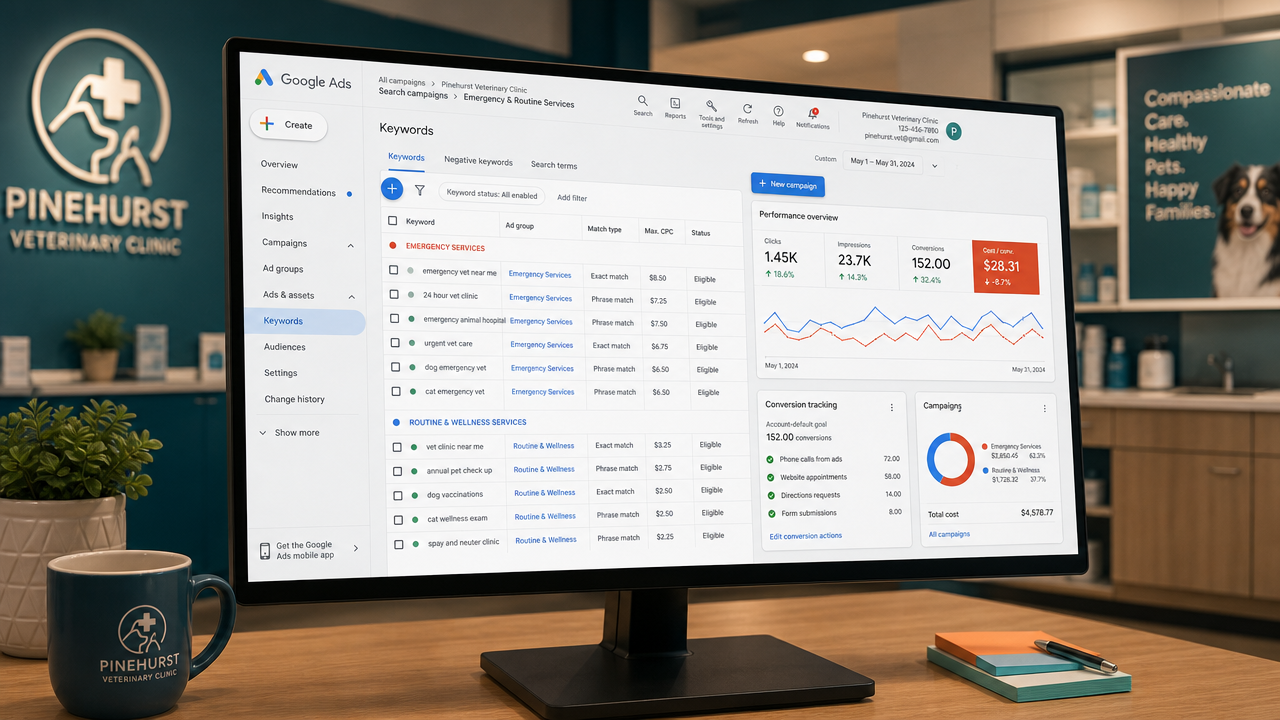
Don’t dump all your keywords into one campaign and expect smart bidding to work magic. Emergency keywords, routine service keywords, branded keywords, and specialty procedures need separate campaigns because each has a different conversion value and urgency.
An emergency appointment might be a $200 to $500 visit. A routine vaccination might be $80 to $150. A dental cleaning under sedation might be $600 to $1,200. Smart Bidding can only optimise toward profit if it knows the difference. When you segment, each campaign learns independently. Emergency campaigns bid aggressively. Routine campaigns bid conservatively. Your overall spend becomes surgical.
Emergency Care Keywords That Capture Urgent Searches
Emergency keywords are the fastest path to high-intent traffic. But you need to choose them strategically to avoid capturing research traffic that won’t convert into bookings.
High-Intent Emergency Keywords
Focus on keywords that signal immediate need: “emergency vet near me,” “vet open now,” “emergency vet 24 hours,” “after-hours vet clinic,” “urgent pet care,” “vet for pet bite,” “tick removal vet,” “pet poisoning emergency,” and location-specific variants like “emergency vet Brisbane” or “emergency vet Sydney.”
These keywords convert like crazy because people are in immediate need. They’ve already decided to visit. Your job is to be visible and make booking dead simple. Ensure your landing page has one-click calling, a mobile-friendly appointment form, and clear directions. Sixty-eight percent of emergency vet searches happen on mobile devices. If your site isn’t optimised for mobile, you’re losing money on every click.
Keywords to Avoid
Generic keywords like “dog,” “cat,” “pet,” or “veterinarian” generate massive impression counts but terrible conversion rates for booking appointments. They’re too broad. Someone searching “dog” might be looking for dog food recipes, dog training classes, or dog toy recommendations. You’ll pay per click and get no appointments.
Similarly, “vet tech jobs” or “become a veterinarian” waste budget. So do keywords aimed at other vets or suppliers. Use negative keywords aggressively. Add “-jobs,” “-training,” “-course,” “-education,” “-supplies,” and “-wholesale” to prevent irrelevant traffic.
The Sweet Spot: Service-Specific, Location-Based, Long-Tail Keywords
Keywords that combine service, location, and specificity show the highest conversion rates. Examples: “dog dental cleaning Brisbane,” “cat vaccination Newcastle,” “puppy vaccination near me,” “paralysis tick removal Gold Coast,” “pet emergency after hours,” “vet for anxious dogs.”
These keywords are less competitive than generic terms, lower cost per click, and attract people who know exactly what they need. Long-tail keywords also win in the AI search era. Australian pet owners are increasingly asking conversational, specific questions rather than typing basic phrases. “Which vet near me is good with anxious dogs?” or “Does my cat need urgent care if limping?” These questions become keywords when people feed them into Google or AI tools.
Structuring Campaigns to Separate Waste from Value
Campaign structure determines whether smart bidding succeeds or drowns in noise. A single sprawling campaign with 500 keywords is a nightmare for any bidding strategy. Separate into four core campaigns.
Campaign 1: Emergency and After-Hours Keywords
These are your highest-priority, highest-value keywords. Emergency searches convert fastest. Bid aggressively. Set a daily budget that reflects urgency. A clinic offering after-hours services should budget $500 to $800 per week for emergency campaigns alone. Use Target CPA bidding set to your average emergency appointment value (often $250 to $400).
Campaign 2: Routine Service Keywords
Vaccinations, checkups, dental cleaning, flea treatments. These keywords convert slower and at lower values. Bid conservatively. Use Target CPA bidding set to $80 to $150 depending on your average routine visit value. This campaign will generate steady volume but lower urgency than emergency searches.
Campaign 3: Branded Keywords
Bid on your clinic’s name. Competitors do it too. If you don’t bid on your own brand, competitors might show up above you when someone searches for you specifically. Branded campaigns are dirt cheap to run: $3 to $5 per conversion compared to $15 to $20 for general terms. Your branded campaigns will have the best ROI of any campaign you run.
Campaign 4: Specialty and Referral Keywords
Dental surgery, orthopedics, dermatology, or other specialist services. If your clinic offers specialties, separate them. Specialty keywords attract high-value appointments, but they’re more competitive and require higher budgets. Plan $5,000 to $15,000 per month per specialty campaign depending on your local market.
Action Steps: Getting Started With Smart Bidding and Emergency Keywords
- Audit your keyword list. Pull your current Google Ads keywords. Segment them into emergency, routine, branded, and specialty buckets. Delete or pause keywords that don’t signal booking intent (generic terms, job listings, educational content).
- Set up conversion tracking correctly. Track phone calls, form submissions, and booked appointments as separate conversion actions. Google’s smart bidding learns from these signals. Without clean conversion data, bidding optimisation fails. Use call extensions with call tracking numbers and mobile-friendly booking forms.
- Start with manual CPC bidding. Run your newly segmented campaigns on manual cost-per-click bidding for 3 to 4 weeks. Gather at least 50 conversions per campaign (preferably per keyword set). This is your learning phase.
- Transition to Target CPA once you have data. After 50+ conversions, switch to Target Cost Per Acquisition bidding for each campaign. Set your target CPA based on your average appointment value. Emergency campaigns should target $200 to $400 CPA. Routine campaigns $80 to $150.
- Optimise landing pages for mobile and urgency. Make sure clicks land on pages with one-tap calling, mobile-friendly forms, clear directions, and fast load times under 3 seconds. Emergency vet pages should emphasise “open now,” “24/7,” and directions to your location prominently.
- Monitor and adjust monthly. Check performance weekly. Look for keywords with high cost per conversion and pause or reduce bids. Identify high-performing keywords and increase bids. After 60 days, your campaigns will stabilise and smart bidding will hum.
So, What Now?
Google Ads for veterinary clinics isn’t about spending more. It’s about spending smarter. Emergency keywords capture people at the moment they need you most. Smart bidding ensures you pay fair prices for those clicks and let machine learning do the heavy lifting. Segmented campaigns prevent waste. Mobile-optimised landing pages convert clicks into calls and bookings.
If your current Google Ads campaigns feel like a cost centre instead of a revenue driver, the issue is usually strategy, not budget. Misaligned keywords, poor conversion tracking, and smart bidding without segmentation guarantee wasted spend. Start with the fundamentals: segment your campaigns, track conversions, and let AI do what it does best: learn from data.
Bleo specialises in Google Ads management for Australian professional services, including veterinary clinics. If you’d like a free audit of your current campaigns to identify where budget is leaking, reach out through Bleo’s contact page.